How to Create a Video Contest: The Complete Step-by-Step Guide
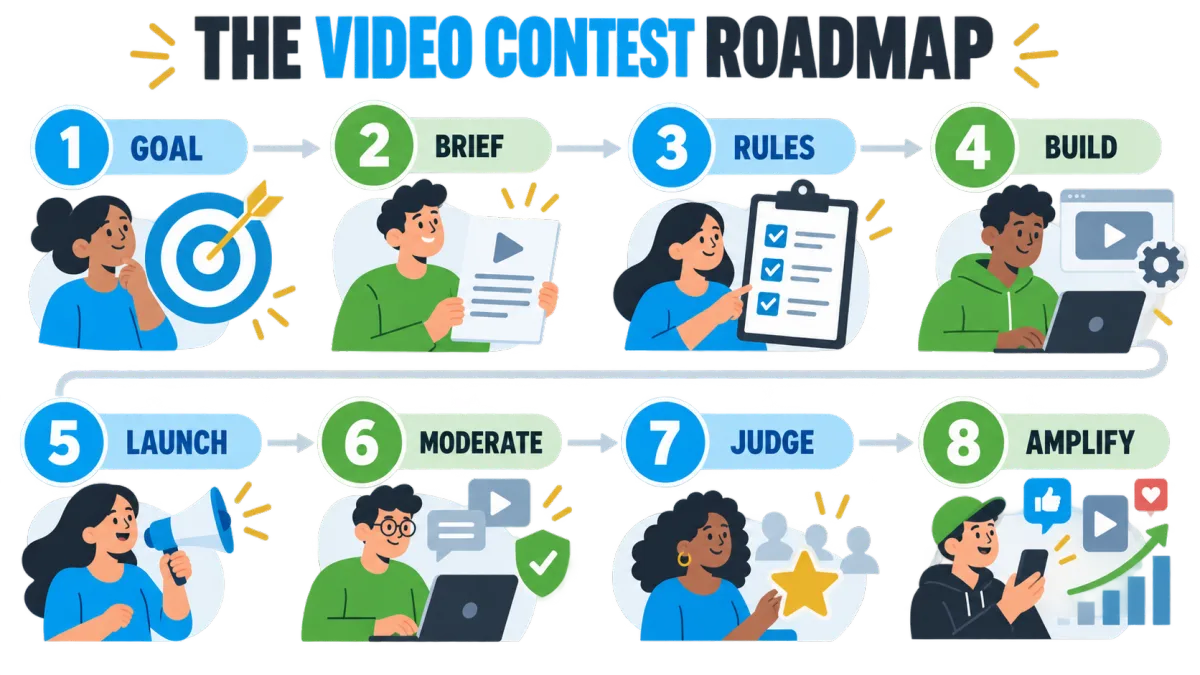
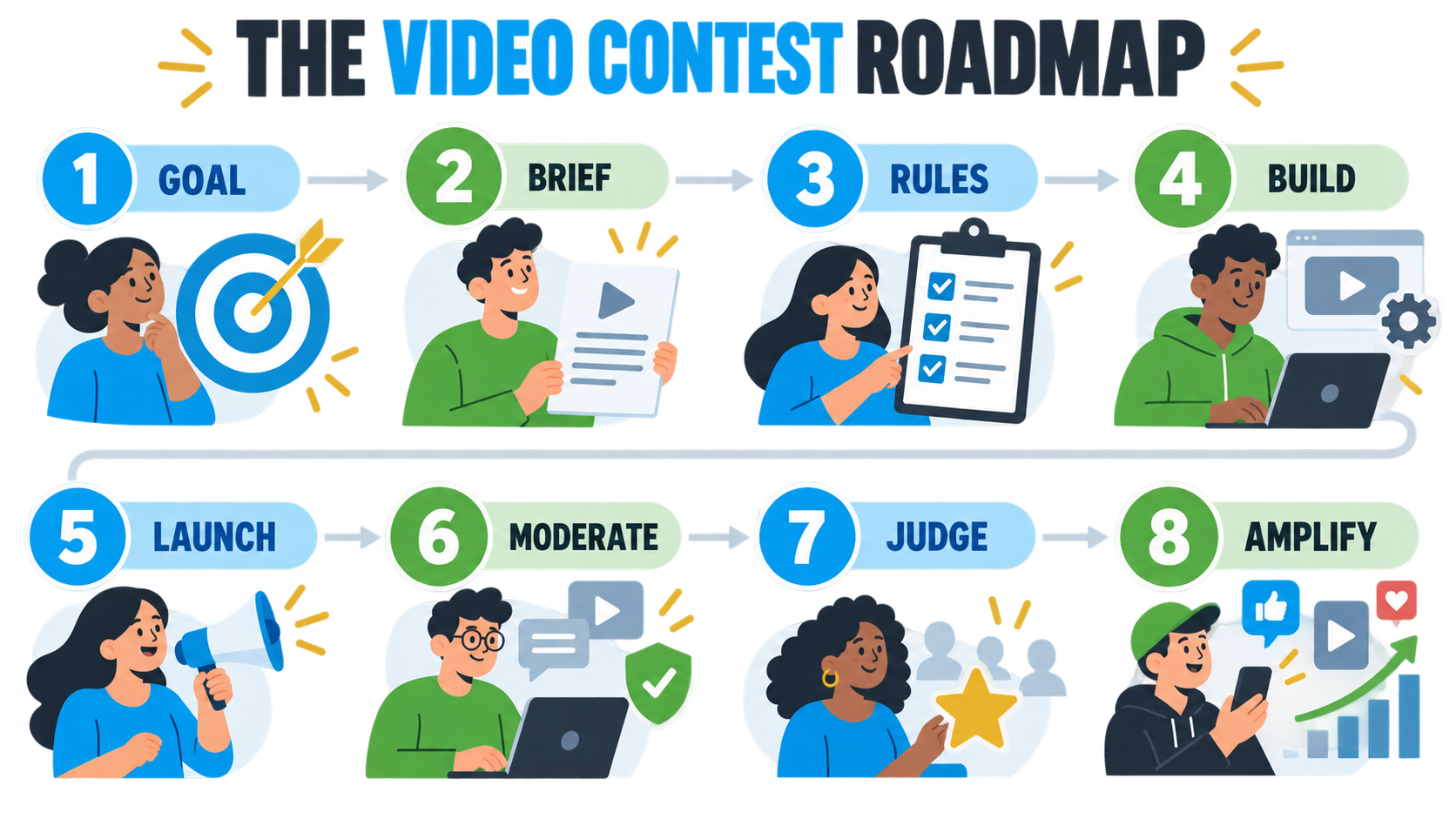
A successful video contest is not just a prompt and a prize. It is a small campaign with a creative brief, official rules, a reliable submission system, a fair judging process, a promotion plan, and a useful life after the winner is announced. This guide shows you how to build every part of it.
Last reviewed September 2026. This article is educational, not legal advice. Laws and platform rules vary by location and change over time; ask qualified counsel to review your promotion before launch.
1. Start with one business goal—not “engagement”
Before choosing a hashtag or prize, write one sentence that explains what the contest must change for the organization. “Increase engagement” is too vague. “Collect 100 permissioned customer stories from current users,” “introduce a new camera to 500 qualified creators,” or “teach high-school students to recognize a scam” gives the team a result it can design for and measure.
The goal determines almost every later choice. A brand-awareness campaign may reward highly shareable short videos and measure qualified reach. A product-education challenge may require entrants to demonstrate a feature and measure correct product usage. A cause campaign may prioritize authentic stories and partner distribution. A filmmaker competition may need longer runtimes, expert judges, screening rights, and a slower review process.
Pick the right promotion model
People often use “contest,” “sweepstakes,” and “giveaway” interchangeably, but they can be legally different. In a skill-based contest, a winner is selected using disclosed judging criteria. In a sweepstakes, chance determines the winner. A lottery usually combines prize, chance, and consideration and is regulated. Video promotions normally work best as skill contests because the work can be evaluated for storytelling, craft, relevance, or originality. Do not casually add a random drawing, required purchase, entry fee, or public vote without legal review.
Write a one-page strategy memo with the primary goal, target entrant, desired video, geographic scope, channels, budget, and three key performance indicators. Useful KPIs include qualified entries, completion rate, cost per qualified entry, permissioned assets collected, email opt-ins, product trials, earned reach, watch time, and post-campaign conversions. Vanity metrics can support the story, but they should not be the whole story.
Define the ideal entrant
“Anyone with a phone” sounds inclusive but usually produces a muddy brief. Decide whether you need customers, students, professional filmmakers, micro-creators, employees, nonprofit supporters, hobbyists, or a specific community. Then interview three to five people like them. Ask what would make the opportunity worth their time, what equipment they use, where they discover opportunities, and what would make them abandon an entry.
The creator’s cost is larger than the entry fee. It includes ideation, production, editing, releases, travel, music, upload time, and the risk of doing unpaid work. Your prize, timeline, and instructions should respect that investment.
2. Turn the strategy into a creator-friendly brief
A creative brief should inspire without hiding the constraints. Open with the opportunity in plain language: what should entrants make, for whom, and why does it matter? Then show the non-negotiables in a scannable block. A creator should be able to understand the theme, format, deadline, eligibility, prize, judging criteria, and submission method in two minutes.
A useful prompt creates a boundary and leaves room inside it. “Make a video about sustainability” is so broad that entrants must guess what success looks like. “In 60 seconds or less, show one habit that helps your neighborhood waste less food” supplies a subject, audience, and runtime while preserving creative choice. If a product must appear, explain how naturally and for how long. If a message or disclosure must be spoken or shown, provide the exact language.
Specify deliverables precisely
List the accepted duration, orientation, resolution, file type, maximum size, language and caption requirements. State whether entrants submit a finished file, an unlisted video link, or a public social post. Explain whether teams are allowed, how many entries one person may submit, and whether previously published work is eligible. If judges will watch on phones, say so. If the winning video must also work in a horizontal advertising placement, request a master and cutdowns instead of surprising the winner later.
Keep mandatory branding light. A long list of logos, slogans, product angles, hashtags, and talking points turns a contest into speculative advertising and makes entries feel identical. Ask only for what the campaign genuinely needs. Separate requirements from optional creative suggestions, and include a downloadable checklist.
Use examples without cloning the answer
Examples help entrants understand production level and tone, but one polished reference can cause dozens of imitations. Show two or three materially different approaches: documentary, comedy, animation, tutorial, or cinematic narrative. Explain why each fits the brief. Do not imply that expensive equipment is required unless professional production is part of the judging standard.
Write for a first-time visitor. Define technical terms, show the deadline with a time zone, and put important constraints in both the landing page and the official rules. Avoid making creators hunt through a PDF for the basic idea.
3. Design a prize creators will value
The prize should be proportionate to the work and credible for the audience. Cash is flexible and easy to understand. Product can be compelling when entrants already want it. Access—such as mentorship, distribution, a paid commission, festival screening, or a meeting with a respected professional—can add value, but it should not be used to disguise a weak prize.
One giant award creates attention; several category prizes create more attainable reasons to enter. A practical structure is a grand prize, two or three category awards, and a small people’s-choice award that does not control the main result. If the campaign serves emerging creators, consider finalist honoraria. They recognize the work involved and can improve both participation and goodwill.
Budget beyond the headline prize
The total campaign budget may include legal review, contest software, landing-page development, creative assets, paid media, partner fees, moderation, accessibility, judging, music licensing, taxes, fulfillment, customer support, and post-production of winning material. Reserve time and money for failed uploads, ineligible entries, winner verification, tax paperwork, and a backup winner.
Publish exactly what winners receive, its approximate retail value when relevant, who pays taxes or travel costs, how and when the prize is delivered, and whether substitutions are possible. “Exposure” should never be described as guaranteed value. If a winner may receive future paid work, separate the guaranteed prize from a possible later relationship.
4. Give the contest enough time
A video entry takes longer than a comment or photograph. Creators may need to form a team, obtain a product, secure a location, record, edit, caption, clear music, collect releases, upload a large file, and fix a technical problem. For a straightforward short-form challenge, four to six weeks of open entry is often a reasonable starting point. Complex briefs, student programs, international campaigns, or work requiring a specific product may need eight to twelve weeks.
Build backward from the announcement date. Allow time for strategy, rules, platform setup, testing, partner recruitment, promotional production, entries, reminders, eligibility screening, judging, winner verification, prize fulfillment, and publication. Do not announce a winner the day after entries close if review will take two weeks.
A sample eight-week public schedule
- Week 1: Launch the contest page, rules, announcement video, email, social posts, and partner toolkit.
- Week 2: Publish a creative tutorial or live question-and-answer session.
- Week 3: Feature the brief, prize, and judging criteria with different examples.
- Week 4: Midpoint reminder; answer recurring questions in a public FAQ.
- Week 5: Share behind-the-scenes guidance or judge interviews without favoring entrants.
- Week 6: Two-week reminder and retarget interested visitors.
- Week 7: One-week and 72-hour reminders; increase support coverage.
- Week 8: Final 24-hour reminders, then close automatically at the stated time.
After closing, schedule a short administrative review before judges receive entries. Then allow enough judging time, verification time, and a buffer for alternates. Tell entrants when they can expect an update, even if only finalists will be contacted.
5. Write official rules people can actually use
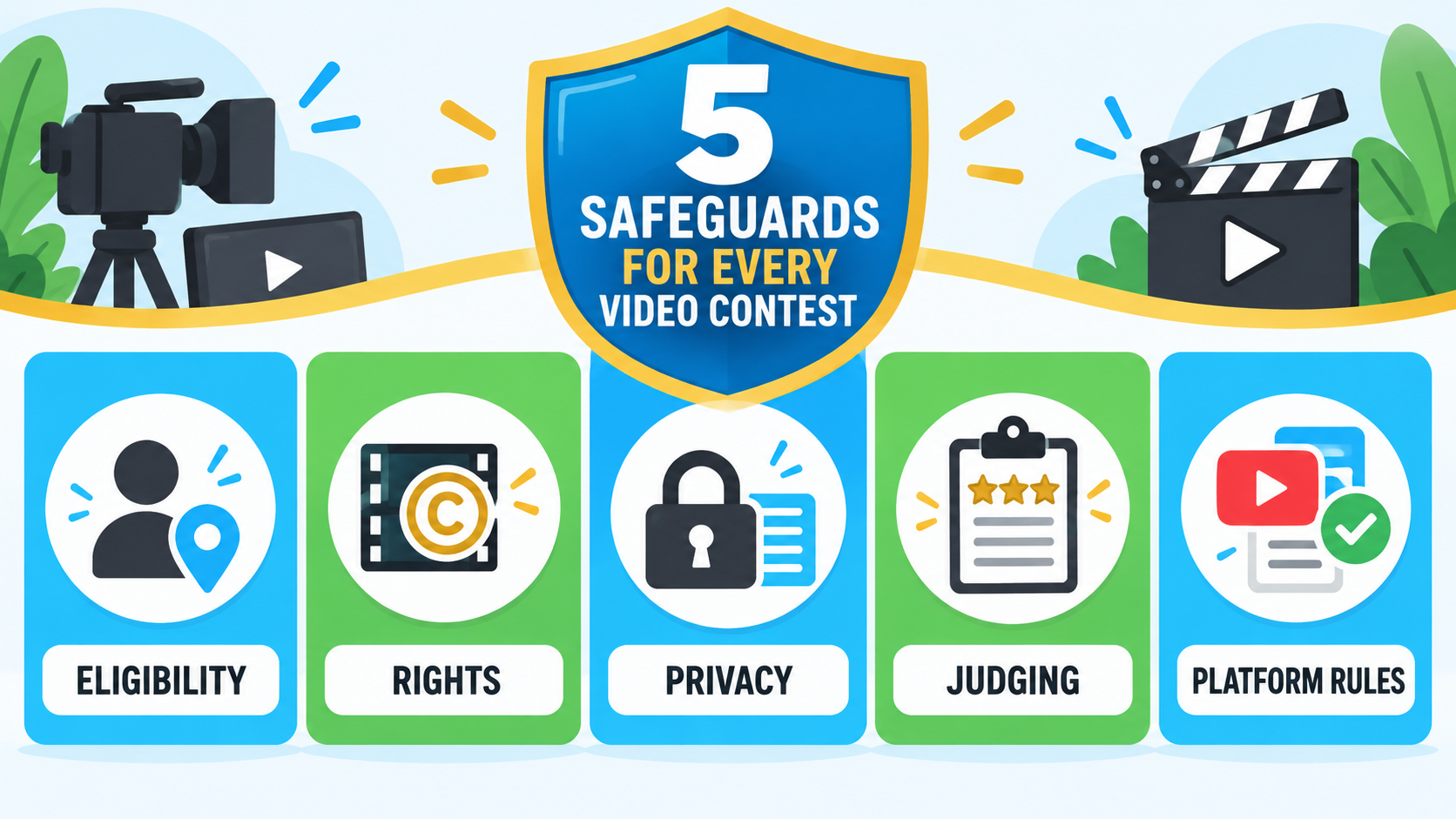
The landing page markets the opportunity; the official rules govern it. Rules should be reviewed by counsel familiar with promotions in every jurisdiction you include. At minimum, address sponsor identity, eligibility, geographic restrictions, age, entry period and time zone, how to enter, technical requirements, entry limits, prohibited material, judging process, tie-breakers, prize details, winner verification, releases, publicity permissions, privacy, taxes, disqualification, cancellation rights, platform disclaimers, governing law, and a way to request winner information when required.
Make the rules easy to find before submission and require entrants to affirm them. Preserve the version that applied during the entry period. If something must change, document the reason, publish the revision date, notify affected entrants, and avoid reducing their odds or promised value.
Eligibility and geography
Specify minimum age and what happens when an entrant is a minor. Define whether employees, contractors, agencies, judges, and household members are excluded. If teams may enter, identify the authorized representative, who receives the prize, and whether every team member must qualify. “Worldwide” is not a substitute for analysis: sanctions, registration requirements, language, tax, prize, and local-promotion laws can make broad eligibility difficult.
Copyright, music, people, and locations
Require entrants to own or have permission for every element they submit: video, photographs, graphics, music, trademarks, performances, locations, and recognizable people. Provide model- and location-release templates when appropriate. A statement such as “no copyrighted material” is misleading because the entrant’s own video is copyrighted. The real requirement is that they control the necessary rights.
Do not assume that a social platform’s music library grants rights for a brand to reuse the video in paid advertising or on another channel. Offer a production-music option, accept silent entries, or clearly explain the license needed. For minors, sensitive stories, medical information, and private locations, add appropriate consent and privacy safeguards.
Use a license, not a rights grab
Most sponsors need permission to display entries, promote the contest, announce winners, and perhaps reuse selected videos in marketing. Define that license by purpose, media, territory, duration, and whether editing is permitted. Avoid demanding ownership of every entry. YouTube’s official contest policy specifically says contests using YouTube cannot require viewers to transfer ownership of their entries, and it also requires official rules, a privacy notice, compliance with applicable law, and a statement that YouTube is not the sponsor.
Consider a limited display license for all eligible entries and a broader negotiated license for winners. If a brand wants perpetual paid-media rights, price that value into the awards and say so prominently before anyone enters. Give creators credit where practical.
Social disclosures and platform rules
If entry requires public brand content, the incentive should be obvious to viewers. The U.S. Federal Trade Commission’s endorsement guidance explains that a vague branded hashtag may not communicate that a post was incentivized; language such as “contest” or “sweepstakes” is clearer. Put the required disclosure in the brief and rules, close to the endorsement—not buried among many hashtags.
Check every platform’s current promotion, branded-content, privacy, music, community, and artificial-engagement rules. YouTube prohibits manipulating views, likes, dislikes, or subscribers and says entry must be free of charge for contests run on its service. Also state that the platform does not sponsor or administer the promotion when its policy requires that disclaimer.
6. Build a submission experience that does not lose good work
The best form is the shortest form that still collects what administration requires. Ask for entrant or team name, contact information, location and age confirmation, video title, short description, file or link, required releases, rule acceptance, and optional marketing consent. Keep contest entry consent separate from promotional email consent. Do not make a newsletter subscription a hidden requirement.
Choose the upload method by considering file size, privacy, review workflow, and entrant skill. Direct upload creates a consistent archive but requires storage, progress indicators, file validation, transcoding, security, and support. A YouTube or Vimeo link is lighter technically, but entrants may misunderstand public versus unlisted settings, change permissions, delete files, or use music that cannot be relicensed. Public social posts generate distribution but complicate collection, rights, edits, deletions, and verification. Many campaigns use a hybrid: a required submission form plus either a file or an accessible link.
Remove predictable friction
Show accepted file types, maximum size, approximate upload time, and a progress bar before the upload starts. Preserve form fields if the file fails. Allow mobile submissions, test slow connections, and send a confirmation email with an entry number and a copy of key details. Provide a support address and define the deadline rule: must the upload begin or finish before closing?
Test the full journey as an entrant, moderator, judge, and administrator. Use iPhone, Android, desktop, assistive technology, multiple browsers, a long filename, maximum-size file, vertical video, non-English characters, and an interrupted connection. Test email delivery and spam placement. Try an ineligible age and country. Confirm that the form stops accepting entries at the correct time zone.
Accessibility and inclusion
Write plain-language instructions, maintain readable color contrast, label form controls, support keyboard navigation, and provide meaningful error messages. Require or encourage captions and supply a transcript option. Explain whether captions count toward the runtime. If the campaign invites multiple languages, identify who will translate entries and captions for judges.
Collect only data you need, describe how it will be used and retained, restrict internal access, and create a deletion schedule. Children’s entries may trigger special consent and privacy obligations such as COPPA in the United States. Get expert advice before collecting personal information from children.
7. Create a judging system entrants can trust
Publish the criteria and their weights. A balanced rubric might allocate 30 percent to connection with the brief, 25 percent to storytelling, 20 percent to originality, 15 percent to execution, and 10 percent to audience impact. The right weights depend on the goal. If professional production quality is not essential, do not let expensive equipment quietly dominate the score.
Translate each criterion into anchored score descriptions. What does a one, three, or five mean for “connection to brief”? Anchors reduce individual interpretation and make judge training faster. Include an administrative eligibility screen before creative judging so judges do not spend time on late, incomplete, or rights-infringing entries.
Choose and prepare judges
Use an odd-numbered panel with relevant expertise and a mix of perspectives. Obtain conflict-of-interest disclosures. Tell judges to recuse themselves from entries involving clients, relatives, employers, investments, or close collaborators. Provide the same files and rubric to every judge, conceal unnecessary personal details, and forbid private contact with entrants.
Run a calibration round. Have all judges score the same small sample, compare results, discuss the rubric, and resolve differences before the real review. Decide in advance how ties, abstentions, technical failures, and suspected rule violations are handled. Preserve score records and written reasons for finalist decisions.
Use public voting carefully
Public voting can create reach, but it often rewards the largest existing audience rather than the best work. It also attracts bots, vote exchanges, duplicate accounts, paid clicks, and aggressive solicitation. A safer design lets public voting choose a separate audience award or contribute a limited percentage of the total score.
Publish voting rules, rate limits, eligibility, opening and closing times, prohibited tactics, audit rights, and the method for resolving suspicious activity. Do not ask people to manipulate platform engagement metrics. If you cannot reliably detect fraud, do not make an open internet vote determine the main prize.
Moderate before publication
If entries appear in a gallery, place them in a prepublication queue. Review for eligibility, unsafe or hateful content, privacy problems, apparent infringement, malicious links, and personally identifiable information. Tell entrants that gallery appearance does not guarantee final eligibility. Set an internal service level for moderation so creators do not wonder whether their upload disappeared.
8. Promote the opportunity like a campaign
A contest rarely succeeds because one announcement post “goes viral.” Build a distribution map before launch. Start with owned channels: website, email, customer community, app notifications, retail or event signage, and employee advocates. Add partners whose audiences match the ideal entrant: film schools, creator newsletters, clubs, nonprofits, trade associations, festivals, production communities, camera groups, and relevant directories.
Give partners a compact toolkit with a short description, square and vertical artwork, email copy, social captions, deadline, tracking link, accessibility text, and contact person. Make it easy to share accurately. Stagger partners across the entry period instead of concentrating every post on launch day.
Build a useful landing page
The page title and introduction should name the opportunity, audience, and prize. Above the fold, show what to make, the deadline with time zone, who can enter, price or free entry, prize, and a clear action. Then explain the brief, examples, timeline, judging, FAQ, rules, privacy, and support. Use original images and real examples rather than generic stock photography when possible.
For search visibility, answer the terms entrants actually use: video contest, filmmaking competition, student video contest, creator challenge, cash prize, free entry, and the subject or region. Use one descriptive page URL, a unique title and meta description, a logical heading hierarchy, compressed images with useful alt text, internal links, and structured data that truthfully represents the page. Do not create dozens of thin pages that repeat the same copy.
Create a message sequence
Launch content explains the opportunity. The next wave demonstrates what a strong idea might look like. Mid-campaign content answers objections: “Do I need professional equipment?”, “Can I enter from my country?”, “Can I use stock footage?”, “How will videos be judged?” Deadline content should become more specific as closing approaches.
Use paid media to amplify a proven message, not to rescue an unclear brief. Create separate ads for creators, customers, students, or professional filmmakers. Retarget people who visited the page but did not submit, while respecting privacy and consent choices. Track each partner and channel with consistent campaign parameters.
A listing on Online Video Contests can complement the sponsor’s own promotion by reaching people already searching for active video opportunities. Keep the official contest page as the source of truth and update third-party listings if deadlines or rules change.
9. Operate the contest while it is live
Assign one owner for decisions and a backup. Create a shared issue log for form failures, eligibility questions, rule interpretations, suspicious entries, complaints, and changes. Draft response templates, but allow a human to handle edge cases. Publish broadly useful answers in the FAQ so every entrant receives the same information.
Monitor submission starts, completed entries, upload failures, source, country, device, and daily volume. A high landing-page conversion with few completed uploads suggests form friction. A large number of ineligible entries suggests unclear promotion or rules. A sudden concentration from one source may be a successful partner—or abuse that needs review.
Do not give private creative coaching that could advantage one entrant. Clarify the rules consistently. If a platform outage or confirmed technical failure affects submissions, follow the extension provisions in the official rules and communicate the decision everywhere the original deadline appeared.
Close cleanly and verify winners
Automatically close the form at the stated time, preserve the submission database, and record late attempts separately. Screen entries against objective eligibility requirements before judging. For finalists, verify identity, age, location, authorship, releases, original files, public-post status, and compliance with required disclosures. Run appropriate rights and brand-safety review.
Contact potential winners privately before announcing them. Use a clear response deadline and an alternate-selection procedure. Collect affidavits, releases, tax forms, and prize-acceptance documents as required. Never request sensitive information through an unexpected social direct message; tell entrants in advance how official contact will occur.
After verification, announce winners on the promised date, credit creators correctly, link to their work where appropriate, and thank all entrants. Tell non-winners whether their entries will remain displayed and how to request removal when the rules permit. Fulfill prizes promptly and keep evidence of delivery.
Turn entries into a permissioned content library
The contest’s value can continue after awards, but only within the permissions entrants granted. Create a rights matrix showing each asset, owner, release status, music status, permitted channels, territory, term, editing rights, credit requirement, and expiration. Do not assume that accepting a social-post link gave the sponsor unlimited advertising rights.
Possible follow-on assets include a winner reel, themed compilations, case studies, recruitment videos, paid creator commissions, customer stories, event screens, classroom resources, and behind-the-scenes interviews. Obtain an additional license if the new use exceeds the original terms. Compensate creators when a new commercial use deserves it.
Measure business value
Report the funnel, not just the winner: unique qualified visitors, entry starts, completion rate, eligible entries, creator diversity, partner referrals, cost per eligible entry, total watch time, earned reach, email opt-ins, product actions, and number of assets with usable rights. Compare results with the goal written at the start.
A simple cost-per-qualified-entry calculation is total campaign cost divided by eligible entries. A content-replacement estimate can compare what it would have cost to commission similarly usable assets, while accounting for the fact that contest entries are not automatically production-ready advertisements. For sales or trials, use tagged links and an agreed attribution window. For brand lift, establish a baseline before launch.
Hold a retrospective within two weeks. Ask entrants where they discovered the contest, what confused them, and what nearly prevented submission. Ask judges which criteria overlapped or failed. Document technical issues, support volume, rights gaps, and partner performance. The next contest should begin with those lessons.
10 common mistakes that weaken video contests
- Starting with a tactic instead of a goal. “Let’s ask people to post a video” is not a strategy. Without a defined outcome, the brief, prize, judging, and measurement pull in different directions. Decide what the organization needs and what the creator receives before choosing a channel.
- Making the assignment feel like unpaid client work. A rigid script, heavy branding, multiple aspect ratios, raw files, perpetual advertising rights, and one small prize ask creators to carry most of the campaign risk. Reduce the required work, strengthen compensation, or commission creators directly.
- Hiding important terms. A beautiful landing page cannot compensate for rules that reveal geographic limits, broad rights, or a different deadline only after someone has produced a video. Put decision-changing terms on the main page and make the complete rules prominent.
- Using one deadline without a time zone. “Ends Friday” is ambiguous across a country and unusable internationally. Publish the date, exact time, and named time zone everywhere, and configure the form to match.
- Overlooking music and talent rights. A creator may legally use a sound inside one social platform while the sponsor cannot reuse that post in an advertisement. Explain the intended use before entry, provide safe music options, and collect releases that match the plan.
- Launching an untested upload. Large files, slow networks, mobile browsers, login requirements, and expired links can silently destroy conversion. Test maximum-size entries and recovery from failure, then monitor abandoned starts while the contest is open.
- Letting popularity equal quality. A pure vote rewards reach and organized voting more than the creative brief. If community participation matters, separate the audience award or limit its contribution to a judge-led score.
- Changing the rules informally. Private exceptions create inconsistency and can undermine trust. Route interpretations through one owner, document them, and publish a clarification for everyone when it affects how entrants participate.
- Going quiet after launch. Creators need reminders, examples, answers, and confidence that the opportunity is real. Plan the full message sequence and keep the official page current through judging and announcement.
- Forgetting the archive. When the contest expires, keep a useful page that clearly says it is closed, links to active opportunities, preserves winners when appropriate, and avoids inviting late entries. This serves visitors, creators, and search engines better than a broken URL.
The complete video contest launch checklist
Strategy and creative
- One primary business goal and defined KPIs
- Specific ideal entrant and geographic scope
- Skill contest, sweepstakes, or other model confirmed
- Clear prompt, runtime, format, orientation, and required messages
- Prize and total operating budget approved
- Realistic entry and judging calendar
Legal and trust
- Official rules reviewed for included jurisdictions
- Eligibility, judging, ties, prizes, taxes, and alternates defined
- Music, talent, location, trademark, and footage rights addressed
- Entry-display and winner-reuse licenses clearly separated
- Privacy notice, retention plan, and consent flows ready
- Platform rules and required disclaimers checked
- Social contest disclosure language supplied
- Minor and accessibility safeguards reviewed
Technology and operations
- Upload or link workflow tested on mobile and desktop
- File limits, progress, recovery, and confirmation work
- Moderation queue and support process assigned
- Judges trained with weighted, anchored rubric
- Conflict, fraud, voting, and audit processes documented
- Winner verification, tax, release, and fulfillment documents ready
- Analytics, campaign links, and dashboard tested
Promotion and follow-through
- Landing page answers the essential questions above the fold
- Email, social, announcement video, ads, and reminders scheduled
- Partner toolkit and tracking links distributed
- FAQ and support response templates prepared
- Winner announcement and creator-credit plan approved
- Rights matrix and post-campaign content plan prepared
- Retrospective date on the calendar
Frequently asked questions
How long should a video contest run?
For a simple short-form challenge, plan roughly four to six weeks of open entry. Use eight to twelve weeks when entrants need a product, team, travel, releases, complex production, school approval, or professional finishing. Add separate time for eligibility review, judging, verification, and announcement.
How much should the prize be?
There is no universal amount. Price the creator’s effort, skill level, rights requested, and audience. The more production you require and the broader the reuse license, the stronger the compensation should be. Several meaningful awards can attract a wider field than a single winner-take-all prize.
Should entry be free?
Many public brand video contests are free to enter, and platforms may require it. Charging a fee or requiring a purchase can materially change the promotion’s legal analysis. Have counsel review the structure before launch.
Should the public choose the winner?
Usually not the main winner. Public voting can expand reach, but it favors entrants with large audiences and creates fraud risk. Use it for a separate audience award or as a limited, audited portion of the overall score.
Can we reuse every submitted video?
Only as the rules and applicable law allow. Use a clearly defined license. Broad commercial reuse may justify separate permission and payment. Confirm music, talent, location, trademark, and other rights before using any entry in advertising.
Can entrants submit a YouTube, TikTok, or Instagram link?
Yes, if the workflow and platform rules support it. A separate entry form is still useful for contact details, eligibility, permissions, rule acceptance, and a durable record. Remember that social music rights and platform access do not necessarily cover the sponsor’s later reuse.
What makes a good judging rubric?
A good rubric reflects the stated goal, uses non-overlapping criteria, assigns weights, and defines what low, medium, and high scores mean. Publish the criteria, train judges on a shared sample, disclose conflicts, and decide tie-breakers before judging begins.
How do we get more entries?
Improve the value proposition and remove friction before buying more traffic. Make the prompt specific, prize credible, timeline realistic, rules readable, upload reliable, and examples varied. Then distribute through organizations and communities that already serve the ideal entrant.
Sources and further reading
This guide was independently written after reviewing the leading current resources for creating video contests and the governing sources below. OVC does not copy contest descriptions or third-party guides.
- YouTube: Contest Policies and Guidelines
- Federal Trade Commission: Endorsement Guides Q&A, including social media contests
- Woobox: Video Contest Best Practices
- Cool Tabs: How to Create a Video Contest
- Easypromos: Video Contest Tutorial
- Jotform: Tips for Running an Online Video Contest
- RQ Awards Platform: Video Submission Practices for Reviewers and Administrators
- World Standards Cooperation: Example Video Contest Rules
